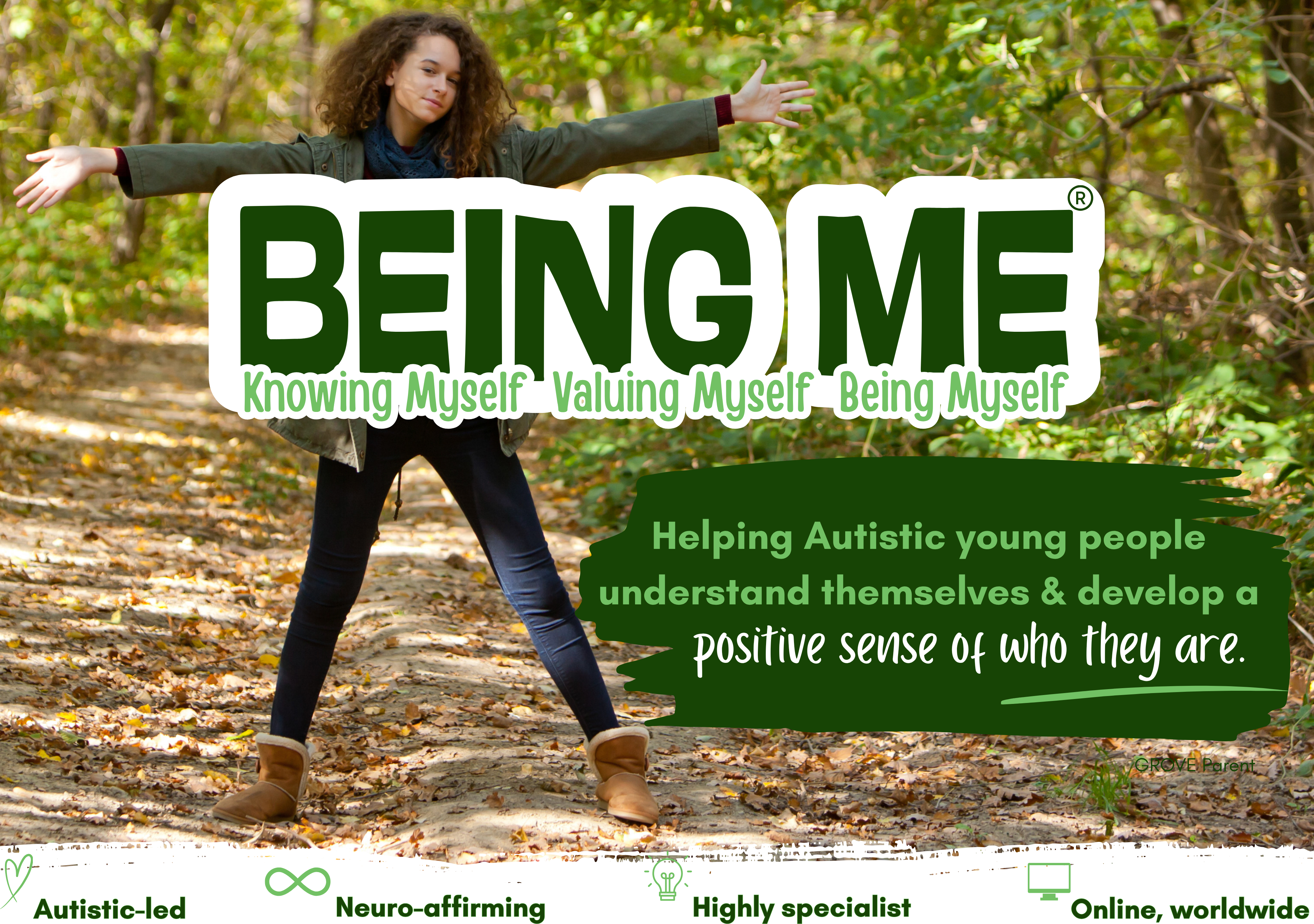
BEING ME is a specialist group programme supporting self-understanding, self-acceptance & wellbeing through a neuro-affirming approach.
BEING ME has been developed by Autistic professionals with extensive experience supporting Autistic children & young people.
The programme combines our lived-experience, academic learning & wider community knowledge to help Autistic young people develop self-understand & gain an affirming perspective of their Autistic identity.
We do not focus on changing Autistic young people – that is fundementally in opposition to everything we believe in – instead we help them feel valued as themselves.
VIEW UPCOMING BEING ME GROUPS & BOOKING INFORMATION
Autistic experience is GROVE's specialism & we are therefore uniquely positioned to support your Autistic young person
What do the young people cover in BEING ME?
Over ten, one hour sessions online, young people are supported by specialist Autistic Mentors to explore their Autistic experience from a neuro-affirming perspective.
Together we’ll explore topics such as:
- Neurodiversity
- Understanding autism (we can also cover ADHD & PDA if relevant to the young people)
- Strengths, challenges & needs
- Sensory experiences & supports
- Communication & socialising
- Self-advocacy
- Wellbeing
BEING ME isn’t a ‘one size fits all’ approach – sessions are adapted to meet the needs of the young people in the group.
BOOKING IS OPEN FOR OUR NEXT GROUPS
HOW PARENTS & CARERS BENEFIT FROM BEING ME TOO:
Being Me is centred around the young person, but we know that understanding yourself as a Autistic young person doesn’t happen in isolation. The adults around them need opportunities to learn and understand too.
That’s why parents and carers aren’t simply sent away with a young person who has learned lots of new things!
Alongside your young person’s participation, you have access to:
Our BEING ME Parent/Carer Guide
A comprehensive guide that accompanies the programme, helping you understand the ideas and concepts we’re exploring. It includes explanations in accessible language, practical ideas and signposting to further learning, so you can keep learning alongside your young person.
GROVE’s recorded webinar library for the duration of the programme
Access to a growing library of recorded GROVE webinars covering topics relevant to neurodivergent young people, families and professionals. You can learn at your own pace, whenever you have the energy and time.
Parent/carer groups
When GROVE parent/carer groups are running, Being Me families will be invited to join for free. These offer opportunities to connect with other parents and carers, share experiences and learn together.
Opportunities to revisit and learn
The learning doesn’t have to stop when the session ends. Parents and carers can revisit resources and recordings and take the time they need to make sense of the ideas being explored.
This will help you develop better understanding of your young person’s experiences and give you more knowledge and tools to support them in ways that respect who they are.
DOWNLOAD OUR BROCHURE TO LEARN MORE & HELP YOUR YOUNG PERSON DECIDE IF BEING ME IS RIGHT FOR THEM WITH OUR RESOURCE FOR YOUNG PEOPLE
'BEING ME' BROCHURE
Suitable for parents/carers & those who may refer or commission.
RESOURCE FOR YOUNG PEOPLE
Supporting young people to make an informed choice about taking part.

“The parent booklet was amazing, very thorough and informative and has allowed me to consolidate knowledge. This will help embed the key information points with my young person going forward.” Parent
“The material provided went above and beyond to give us all the information we would need to support our young people in their engagement. It was clearly very well thought out.” Parent
“Honestly his willing participation is HUGE. I very much was not sure if he’d sit for the group, so the fact that he’s staying engaged is pretty amazing. I credit it to the way you are incorporating all of the young people’s interests so beautifully and making it clear that they can participate how and if they want to. I appreciate you!” Parent

“The key aspect was the flexibility within the structure – so being able to catch up with the video replays, being able to eat during the sessions, or move around. It was ok to leave before the end if needed as well. This felt really different and also accommodating.” Parent
“The interactive aspects of the course exceeded my expectations (along with no pressure to participate if the young person didn’t want to). It was truly child focused – which a lot of people try to be, but Grove actually is.” Parent
“It was honestly brilliant, each week flowed naturally and all activities were valuable.” Parent
“Brilliant. The Mentors are so engaging, open, friendly and inclusive. Your ability to meet the needs of everyone in the group, create a truly safe, inclusive and affirming space is so valuable. My young person really appreciated hearing your own experiences too.” Parent
BEING ME INCLUDES
- Specialist facilitation with GROVE’s Autistic Mentors – BEING ME cannot be accessed anywhere other than directly with us!
- 10 x 1 hour group sessions that are adapted to meet the needs of the young people attending
- Recorded access for the duration of the programme & 7 days following
- A choice of optional Activity Booklets to support alongside the sessions
- A detailed Parent/Carer Knowledge Guide ensuring you are able to learn too
- Access to our free parent/carer resource library & community events for the duration of the programme
CAN BEING ME BE FUNDED?
Many families across the UK successfully access funding for BEING ME through EHCPs, EOTAS/EOTIS packages, schools, Short Breaks funding, Personal Health Budgets, DLA, charities & other professional funding routes.
If you are seeking funding, please get in touch. We can provide a supporting letter outlining the aims & potential benefits of the programme, which can help funders understand how BEING ME may meet your young person’s needs.
£500 – Funded Rate
If your child’s place is being funded by a school, Local Authority, charity or another organisation, a £50 booking deposit is required to secure their place while funding arrangements are completed.
The deposit will be refunded once full payment has been received from the funding organisation.
Funding confirmation or payment from the family (if funding is declined and you choose to self-fund) must be received 14 days before the programme begins. If this has not been received, the place may be released and offered to another young person.
If you are unsure about funding, please contact us before booking.
For further information view full T&Cs.
SELF-FUNDING COSTS
For self-funding families we offer BEING ME on a sliding scale because we want it to be accessible to as many young people as possible, whilst ensuring GROVE can continue developing & delivering neuro-affirming support.
£500 – Sustaining Rate
For families who are able to pay the full programme cost. Choosing this rate helps sustain GROVE’s work, ensures staff are paid fairly for their work & enables us to make lower-cost places available for other young people.
£375 – Supported Rate
For families who need a reduced fee whilst still contributing towards the majority of the programme costs.
£250 – Accessible Rate
This rate is intended only for families on a low income or experiencing financial hardship, where paying a higher rate would make participation difficult or impossible.
We offer this rate on a trust basis and don’t ask for evidence of financial circumstances. If your family is able to choose one of the higher rates, your contribution helps make this accessible option available to others & ensures the future of GROVE’s support.
PAYMENT OPTIONS
If you are paying for your child’s place yourself, you can choose to:
- Pay in full within 24 hours of booking, or
- Pay in two parts: 50% within 24 hours of booking and the remaining 50% on the 1st of the month that the programme begins.
Your child’s place is secured once the first payment has been received. The full programme fee must be paid before the programme starts.
The programme fee covers the complete BEING ME experience, including planning, resources and all sessions. It is not a payment for individual sessions, so the full fee remains payable even if your child is unable to attend all sessions.
PAY WHAT YOU CAN WAITING LIST
We also maintain a waiting list for a limited number of Pay What You Can places.
As these spaces depend on programme viability & available funding, we cannot guarantee availability. If a place becomes available, we will contact families on the waiting list directly. This is most likely to happen in the week leading up to the programme start date.
To join the waiting list, please complete the form below and we will be in touch if we are able to offer a place.
Are you & your young person ready for BEING ME?
To get the most from the experience, your young person needs to be in a place where they are able & willing to take part in a way that works for them.
-
If they are in the depths of burnout, this may not be the right time because their nervous system may need rest & safety more than exploration right now.
-
A gentle curiosity about what being Autistic means to them is also important. Without that spark of interest, it can be hard for them – & for you – to get much from the sessions.
-
They need to feel okay about being online in a small peer group.
We can’t predict the exact feel of each group. Some become very lively & chatty, others are quieter, with young people contributing mainly through the typed chat. Both are completely welcome & equally valued.
Many parents find watching the recordings themselves extremely valuable, as it builds neuro-affirming knowledge, language & tools that can gently support their child with outside the sessions.
Some families also find it helpful to share short sections, or to “strew” the recordings & let their young person dip in when it feels safe & interesting to them. Our hope is always that your young person can attend live, but if they can’t, there are still meaningful ways to gain a great deal from the programme.
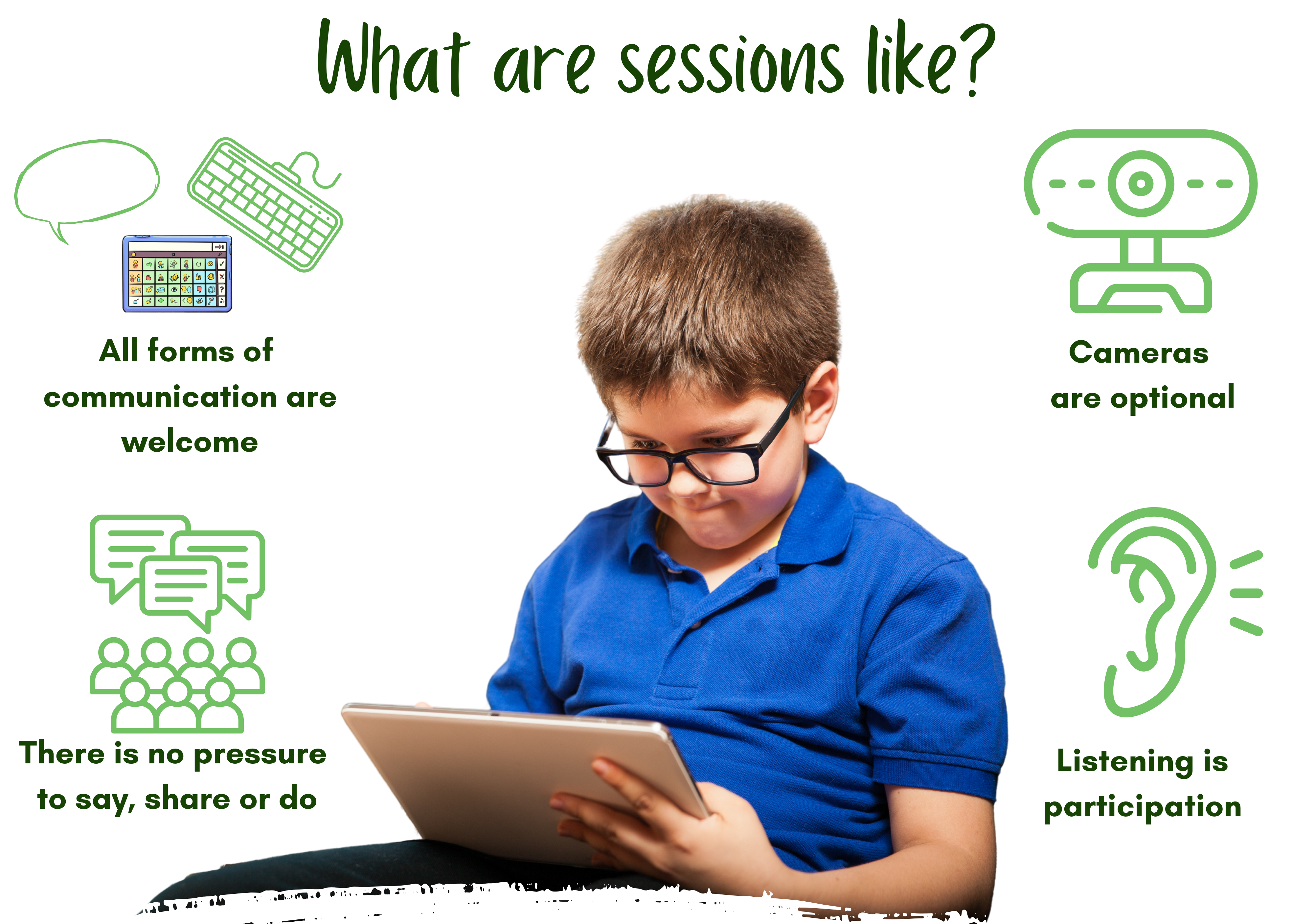
Our approach is fully neuro-affirming. We radically accept engagement, participation & communication in all forms. When we say everything is an invitation, we genuinely mean it: we never force or coerce.
We invite you, as parents & carers, to hold that same stance at home – to welcome engagement however it shows up & to offer participation without pressure, expectation, or a sense that there is a “right” way to take part. Sometimes showing up quietly, listening, doodling, gaming, playing, having the camera off, or watching later is exactly what a young person needs. If they are accessing whilst at school, you may need to coach the staff to approach it in that manner too.
We challenge the medical model. We tell young people that we do not see autism as a condition or disorder & we share the growing body of knowledge that supports this view. We gently invite them to think about this & decide what feels true for them.
We give space for exploring concepts of disability & we do not advocate for calling autism a “superpower” (although if a young person brings that to the group themselves we will not challenge, just gently offer alternative perspectives.
This means that some things may be explained differently from what you have previously been told, or what you may have shared with your child. Understanding of autism, ADHD, PDA & other neurodivergence is (thankfully) evolving as neurodivergent people themselves increasingly lead the research & narrative. It is our responsibility to keep up with this & we take that responsibility seriously.
We are open with young people about uncertainty, about differing opinions & about the fact that knowledge will continue to grow & change. They are at the beginning of a lifelong journey of self-understanding.
Some young people will need significant co-regulatory support from a parent or carer in order to participate & for their experience – & that of the group – to feel safe & positive. We therefore ask that you are available during group times to offer that support if needed.
Ongoing communication is really important. We will ask you to let us know how your child is doing, what’s helping, what’s hard & any ideas you have for how we can adapt to support them better.
BEING ME is not a one-size-fits-all programme – each week involves reflection, re-planning & re-resourcing so that we can stay responsive to the young people in the group & your insights are a vital part of that.
Does that feel right for you & your young person?
TIME ZONES & SESSION TIMES
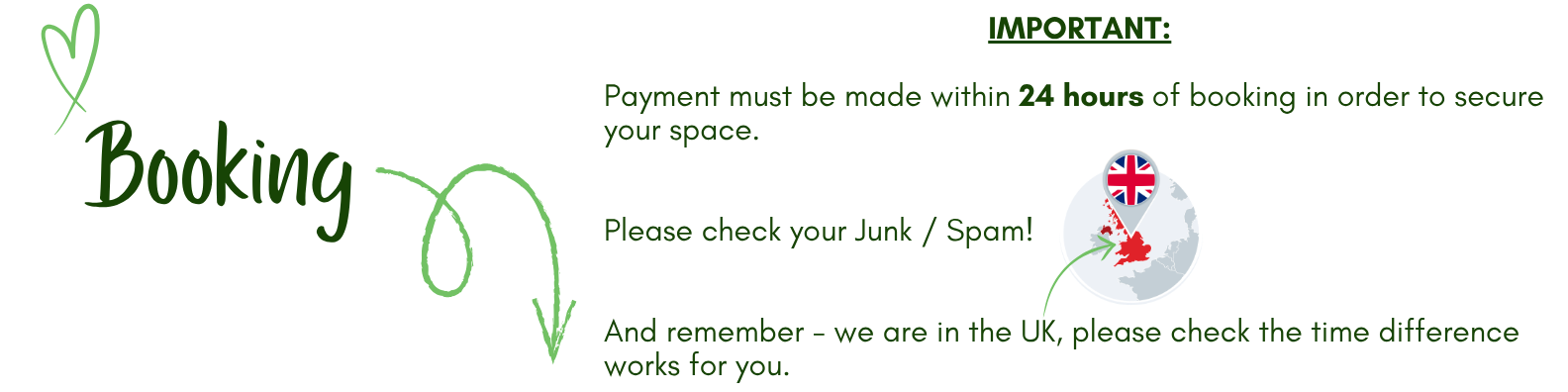
BEING ME is delivered by GROVE as a UK-based service. All session times are listed in UK time (GMT/BST).
If you are joining from outside the UK, please check the session time carefully in your own time zone before booking. Participants are responsible for checking how UK time changes throughout the year, including when clocks move forwards or backwards for daylight saving time.
Please ensure that the scheduled session times will work for your child before booking. Bookings confirm acceptance of the published session times, and changes to personal circumstances or difficulties attending at the booked time do not qualify for a refund.
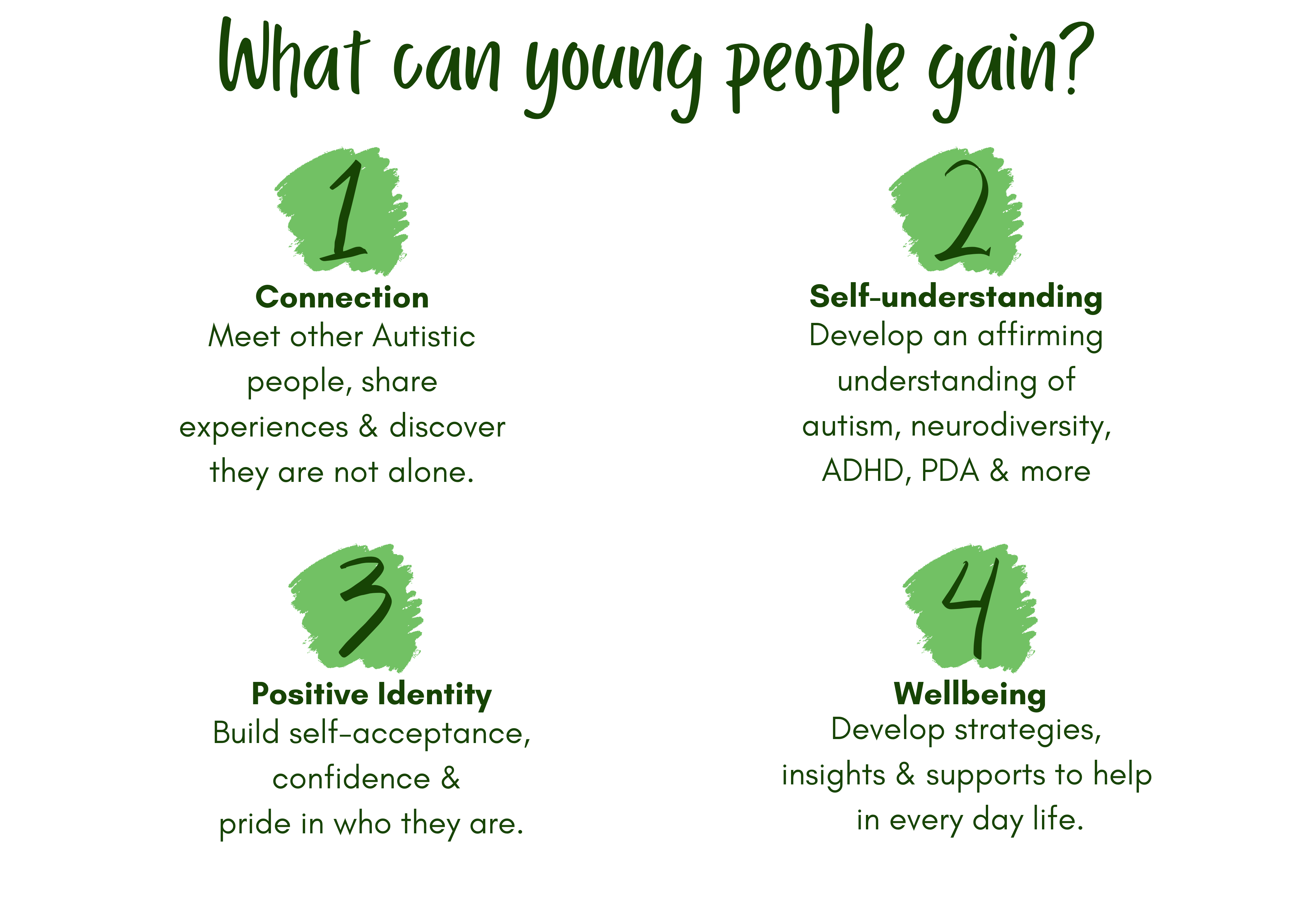
BEING ME HELPS AUTISTIC YOUNG PEOPLE WITH:

Connection to other Autistic people with similar lived experience
Validation, acceptance, belonging
Accurate, affirming information about autism
A safe environment to explore their emerging identity
A chance for to overcome feelings of self-stigma & shame
The most up to date affirming autism research
Knowledge to advocate for needs
Self-understanding, self-compassion, self-confidence
An opportunity to ask questions of Autistic adults & Autistic peers
THE IMPORTANTANCE OF SELF-UNDERSTANDING & A POSITIVE AUTISTIC IDENTITY
GROVE does not support the use of pathologising language & framing of autism in some of the following academic work however this does not mean we have nothing to learn from the research itself:
“The report needs to foster a positive Autistic identity… The report also needs to signpost a young person and their family to how they can connect with the Autistic community…” (Hartman, O’Donnell-Killen, Doyle, Kavanagh, & Day, 2025, p. 281)
“First and foremost, we recommend that the young person connect with their Autistic peers. The importance of building a community with people who share similar neurological experiences can’t be overstated… They will gain from being around like-minded peers who accept them, which, in turn, will help them to learn to accept themselves.” (Hartman, O’Donnell-Killen, Doyle, Kavanagh, & Day, 2025, p. 285)
Studies have shown that learning about autism has been associated with “improved self-advocacy skills (60%), enhanced self-awareness of personal strengths (69%)” and indeed that when young people sought that information from other Autistic people there were better outcomes regarding self-esteem (Keily et al., 2020).
Particularly for young people the notion of ‘identity’ and ‘being Autistic’ has important connections thus “post-diagnostic support for young people and families to include opportunities to reflect on the diagnosis with others and exploration of the best ways to talk about autism is also recommended” (Mesa & Hamilton, 2022).
Cooper et al. (2023) state: “Moreover, developing a sense of pride in their autism identity may be more challenging in youth than for adults who may be in environments where they are less likely to face daily harassment and stigmatisation. Our research indicates that having a positive sense of one’s autism identity in adolescence and young adulthood is still associated with better mental health, despite the additional challenges that autistic young people face in making sense of their identities… Promoting a balanced sense of autism identity, including positive elements as well as acknowledging challenges, will be supportive of well-being in autistic young people.”
Cooper et al. (2021): “Our findings provide evidence that developing a balanced view of autism, with emphasis on strengths associated with autism can have a positive effect for the collective self-esteem to the extent that the individual has a sense of affiliation with other autistic people. While this may happen ‘naturally’ for individuals over time, efforts by educational settings and support services may not only speed this process up, but also reduce the length of time spent living with a solely negative view of the condition. This may be particularly pertinent for early intervention with younger people post-diagnosis and our findings are highly supportive of endeavours … developing a more comprehensive and balanced view of the autism diagnosis.”
Frequently Asked Questions:
WHAT SIZE ARE THE GROUPS?
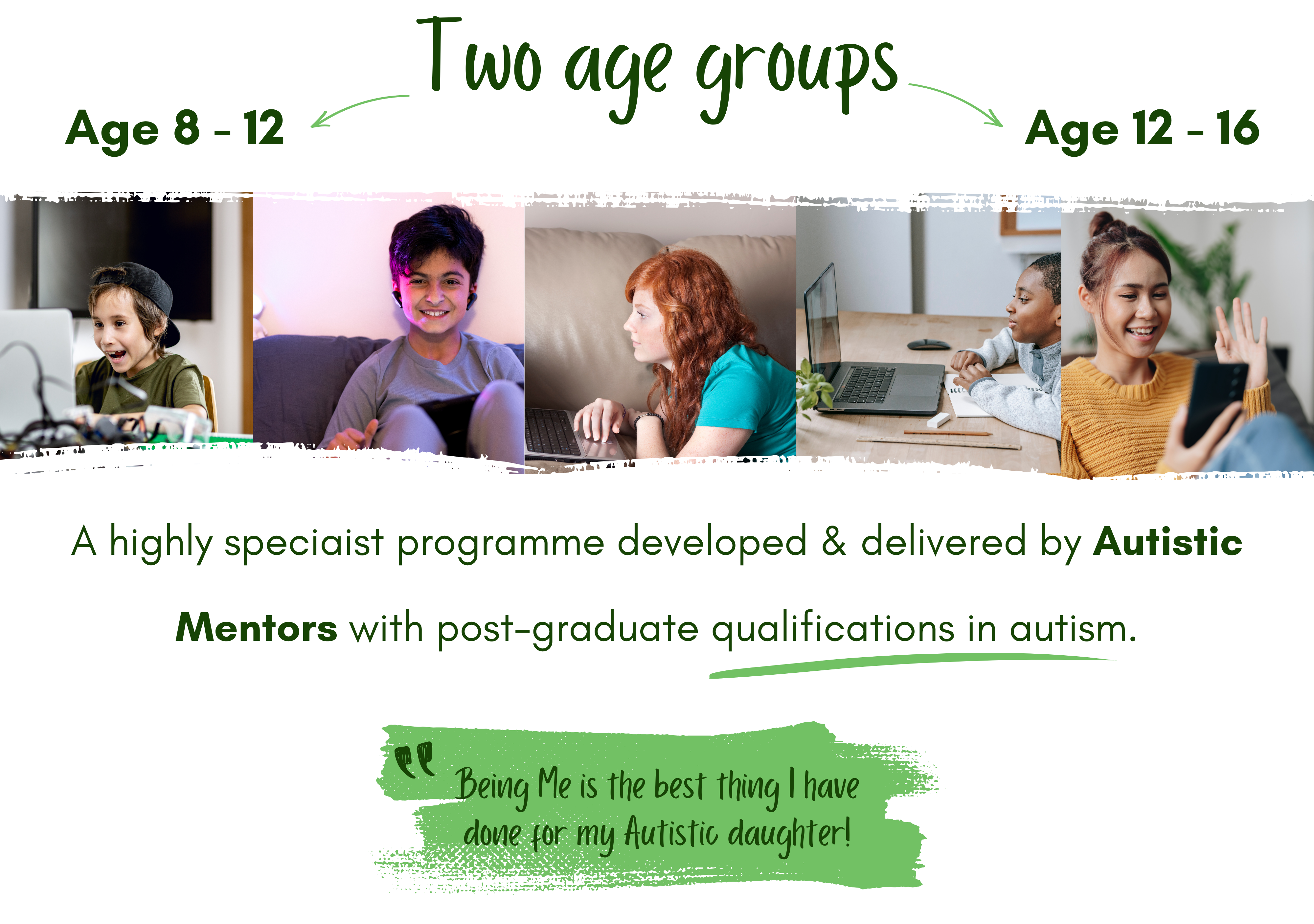
Ages 8-12 are between 4 and 8 young people with 1 or 2 Mentors.
Ages 12-16 are between 4-10 young people with 1 or 2 Mentors.
WILL YOUR APPROACH BE JUST ABOUT STRENGHTS & POSITIVES?
That depends – if your child is not ready to face some of the reality of myths & stigma surrounding autism then yes, we can plan a bespoke approach through individual mentoring that could approach their initial exploration solely in this way. If we have a group of similar children / young people then we may be able to group individuals with that vision in mind too.
But ideally our preference is a truthful, value-neutral approach to autism where we explore strengths & are honest about challenges.
CAN MY CHILD PARTICIPATE WITH THEIR CAMERA OFF?
Yes! We have guidelines for safety to verify who is in attendance but we are very happy working with our mentees off camera.
IS BEING ME AVAILABLE TO CHILDREN & YOUNG PEOPLE OUTSIDE THE UK?
Yes! We are able to welcome young people for whom an English speaking programme is suitable.
WHY DOES BEING ME COST MORE THAN A BOOK OR ON-DEMAND RESOURCE?
BEING ME is much more than reading material – it’s a fully-supported programme. Participants receive:
-
10 hours of live online mentoring, led by Autistic Mentors with lived experience and specialist training
-
Tailored support: Mentors spend hours outside of sessions adapting content and communicating with parents/carers so each participant’s needs are met as far as we are able
-
Additional resources: Our exclusive activity and parent/carer booklets
-
Expertly-developed content: The programme reflects extensive research, reflection, and development by the GROVE team
-
Social and identity-focused outcomes: improving self-understanding, self-acceptance, and confidence
All of this represents a level of personalisation and professional specilism. The investment ensures your young person receives high-quality, neuro-affirming support that meets their unique needs.
REFERENCES FOR WORK ABOVE
REFERENCES:
- Cooper, R., Cooper, K., Russell, A.J. et al (2021). “I’m Proud to be a Little Bit Different”: The Effects of Autistic Individuals’ Perceptions of Autism and Autism Social Identity on Their Collective Self-esteem. J Autism Dev Disord 51, 704–714. https://doi-org.hallam.idm.oclc.org/10.1007/s10803-020-04575-4
- Cooper, K., Russell, A. J., Lei, J., & Smith, L. G. (2023). The impact of a positive autism identity and autistic community solidarity on social anxiety and mental health in autistic young people. Autism, 27(3), 848–857. https://doi-org.hallam.idm.oclc.org/10.1177/13623613221118351
-
Hartman, D., O’Donnell-Killen, T., Doyle, J. K., Kavanagh, M., & Day, A. (2025). The neurodiversity affirmative child autism assessment handbook. Jessica Kingsley Publishers.
- Kiely, Bridget; Adesman, Andrew; Rapoport, Eli; Gutman, Alyson. (2020) Patterns and Outcomes of Diagnosis Disclosure to Youth with Autism Spectrum Disorder. Journal of Developmental & Behavioral Pediatrics 41(6):p 443-451. https://doi.org/10.1097/DBP.0000000000000802
- Mesa, S., & Hamilton, L. G. (2022). “We are different, that’s a fact, but they treat us like we’re different-er”: understandings of autism and adolescent identity development. Advances in Autism, 8(3), 217-231. https://doi.org/10.1108/AIA-12-2020-0071
WILL YOU ACCOMMODATE ALL FORMS OF COMMUNICATION? MY CHILD IS NON-SPEAKING.
Yes, absolutely! We will discuss with you how we can support your child to access our services.
DO YOU HAVE A PROGRAMME THAT WOULD WORK IN SCHOOLS?
Yes, BEING ME can be delivered to individual students in school by GROVE – they just need a private space and a computer. Please contact us to discuss the option of a bespoke group just for your school.
MY CHILD CANNOT JOIN GROUPS - CAN THEY DO BEING ME ON THEIR OWN?
Through 1:1 mentoring we can explore their Autistic experience – reach out to us & we can discuss more.
CAN I PAY IN INSTALMENTS?
We offer the option of paying in full within 24 hours of booking or selecting to pay 50% within 24 hours of booking and then the remaining 50% on the 1st of the month where the programme starts.
WHERE ARE YOU BASED?
BEING ME is delivered by GROVE as a UK-based service. All session times are listed in UK time (GMT/BST).
If you are joining from outside the UK, please check the session time carefully in your own time zone before booking. Participants are responsible for checking how UK time changes throughout the year, including when clocks move forwards or backwards for daylight saving time.
Please ensure that the scheduled session times will work for your child before booking. Bookings confirm acceptance of the published session times, and changes to personal circumstances or difficulties attending at the booked time do not qualify for a refund.
VIEW COSTS FOR FUNDED OR SELF-FUNDED PLACES
CAN BEING ME BE FUNDED?
Many families across the UK successfully access funding for BEING ME through EHCPs, EOTAS/EOTIS packages, schools, Short Breaks funding, Personal Health Budgets, DLA, charities & other professional funding routes.
If you are seeking funding, please get in touch. We can provide a supporting letter outlining the aims & potential benefits of the programme, which can help funders understand how BEING ME may meet your young person’s needs.
£500 – Funded Rate
If your child’s place is being funded by a school, Local Authority, charity or another organisation, a £50 booking deposit is required to secure their place while funding arrangements are completed.
The deposit will be refunded once full payment has been received from the funding organisation.
Funding confirmation or payment from the family (if funding is declined and you choose to self-fund) must be received 14 days before the programme begins. If this has not been received, the place may be released and offered to another young person.
If you are unsure about funding, please contact us before booking.
For further information view full T&Cs.
SELF-FUNDING COSTS
For self-funding families we offer BEING ME on a sliding scale because we want it to be accessible to as many young people as possible, whilst ensuring GROVE can continue developing & delivering neuro-affirming support.
£500 – Sustaining Rate
For families who are able to pay the full programme cost. Choosing this rate helps sustain GROVE’s work, ensures staff are paid fairly for their work & enables us to make lower-cost places available for other young people.
£375 – Supported Rate
For families who need a reduced fee whilst still contributing towards the majority of the programme costs.
£250 – Accessible Rate
This rate is intended only for families on a low income or experiencing financial hardship, where paying a higher rate would make participation difficult or impossible.
We offer this rate on a trust basis and don’t ask for evidence of financial circumstances. If your family is able to choose one of the higher rates, your contribution helps make this accessible option available to others & ensures the future of GROVE’s support.
PAYMENT OPTIONS
If you are paying for your child’s place yourself, you can choose to:
- Pay in full within 24 hours of booking, or
- Pay in two parts: 50% within 24 hours of booking and the remaining 50% on the 1st of the month that the programme begins.
Your child’s place is secured once the first payment has been received. The full programme fee must be paid before the programme starts.
The programme fee covers the complete BEING ME experience, including planning, resources and all sessions. It is not a payment for individual sessions, so the full fee remains payable even if your child is unable to attend all sessions.
OUR NEXT GROUPS BEGIN IN NOVEMBER!
IMPORTANT: Our booking system cannot be configured with the variety of payment options for Being Me. This is not a free programme (as much as we wish it could be!) – please see costs above.
Not quite ready yet?
Use this form to join our ‘expression of interest’ list & you will be offered priority booking for spaces in the next groups.